Welcome to India

India, officially the Republic of India (Hindi: Bhārat Gaṇarājya) , is a country in South Asia.India is rich in culture,traditions,heritage buildings, temples , forts and palaces. Famous Indian Monuments includes Old Churches of Goa ,The Taj Mahal, Qutab Minar of Delhi, Charminar, Red fort and Jantar mantar, these are also few most visited Heritage Sites in India Read more.
10 awesome Monuments of India
Taj Mahal

The Taj Mahal 'Crown of the Palace', is an ivory-white marble mausoleum on the right bank of the river Yamuna in the Indian city of Agra. It was commissioned in 1632 by the Mughal emperor Shah Jahan (r. 1628–1658) to house the tomb of his favourite wife, Mumtaz Mahal; it also houses the tomb of Shah Jahan himself. The tomb is the centrepiece of a 17-hectare (42-acre) complex, which includes a mosque and a guest house, and is set in formal gardens bounded on three sides by a crenellated wall.
Red Fort

The Red Fort or Lal Qila (Hindustani: [laːlqiːlaː]) is a historic fort in Old Delhi, Delhi in India that served as the main residence of the Mughal Emperors. Emperor Shah Jahan commissioned construction of the Red Fort on 12 May 1638, when he decided to shift his capital from Agra to Delhi. Originally red and white, its design is credited to architect Ustad Ahmad Lahori, who also constructed the Taj Mahal. The fort represents the peak in Mughal architecture under Shah Jahan, and combines Persianate palace architecture with Indian traditions.On 15 August 1947, the first Prime Minister of India, Jawaharlal Nehru, raised the Indian flag above the Lahori Gate. Every year on India's Independence Day (15 August), the Prime Minister hoists the Indian tricolour flag at the fort's main gate and delivers a nationally broadcast speech from its ramparts.
Qutub Minar

The Qutb Minar was built over the ruins of the Lal Kot, the citadel of Dhillika. Qutub Minar was begun after the Quwwat-ul-Islam Mosque, which was started around 1192 by Qutb-ud-din Aibak, first ruler of the Delhi Sultanate.It is usually thought that the tower is named for Qutb-ud-din Aibak, who began it. It is also possible that it is named after Khwaja Qutbuddin Bakhtiar Kaki a 13th-century sufi saint, because Shamsuddin Iltutmish was a devotee of his.
Char Minar

The fifth ruler of the Qutb Shahi dynasty, Muhammad Quli Qutb Shah, built the Charminar in 1591 after shifting his capital from Golkonda to the newly formed city of Hyderabad.The Charminar (lit. 'four minarets') constructed in 1591, is a monument located in Hyderabad, Telangana, India. The landmark has become known globally as a symbol of Hyderabad and is listed among the most recognised structures in India. It has also been officially incorporated as the Emblem of Telangana for the state of Telangana.[3] The Charminar's long history includes the existence of a mosque on its top floor for more than 400 years.
Hawa Mahal

The Hawa Mahal is a palace in the city of Jaipur, India. Built from red and pink sandstone, the palace sits on the edge of the City Palace, Jaipur, and extends to the Zenana, or women's chambers. The structure was built in 1799 by the Maharaja Sawai Pratap Singh , the grandson of Maharaja Sawai Jai Singh, who was the founder of the city of Jaipur, India. He was so inspired by the unique structure the of Khetri Mahal that he built this grand and historical palace. It was designed by Lal Chand Ustad. Its five-floor exterior is akin to a honeycomb with its 953 small windows called Jharokhas decorated with intricate latticework
Sanchi Stupa 2

The Stupa No. 2 at Sanchi, also called Sanchi II, is one of the oldest existing Buddhist stupas in India, and part of the Buddhist complex of Sanchi in Madhya Pradesh. It is of particular interest since it has the earliest known important displays of decorative reliefs in India, probably anterior to the reliefs at the Mahabodhi Temple in Bodh Gaya, or the reliefs of Bharhut. It displays what has been called "the oldest extensive stupa decoration in existence". Stupa II at Sanchi is therefore considered as the birthplace of Jataka illustrations.
Sun Temple

Konark Sun Temple is a 13th-century CE (year 1250) Sun temple at Konark about 35 kilometres (22 mi) northeast from Puri on the coastline of Odisha, India. The temple is attributed to king Narasimhadeva I of the Eastern Ganga dynasty about 1250 CE. Dedicated to the Hindu Sun God Surya, what remains of the temple complex has the appearance of a 100-foot (30 m) high chariot with immense wheels and horses, all carved from stone. Once over 200 feet (61 m) high,much of the temple is now in ruins, in particular the large shikara tower over the sanctuary; at one time this rose much higher than the mandapa that remains. The structures and elements that have survived are famed for their intricate artwork, iconography, and themes, including erotic kama and mithuna scenes. Also called the Surya Devalaya, it is a classic illustration of the Odisha style of Architecture or Kalinga architecture
India Gate

The India Gate (formerly known as the All India War Memorial) is a war memorial located astride the Rajpath, on the eastern edge of the "ceremonial axis" of New Delhi, formerly called Kingsway. It stands as a memorial to 90,000 soldiers of the British Indian Army who died in between 1914 and 1921 in the First World War, in France, Flanders, Mesopotamia, Persia, East Africa, Gallipoli and elsewhere in the Near and the Far East, and the Third Anglo-Afghan War. 13,300 servicemen's names, including some soldiers and officers from the United Kingdom, are inscribed on the gate. Designed by Sir Edwin Lutyens, the gate evokes the architectural style of the memorial arch such as the Arch of Constantine, in Rome, and is often compared to the Arc de Triomphe in Paris, and the Gateway of India in Mumbai.
Ajanta Ellora Caves

The Ajanta Caves are approximately 30 rock-cut Buddhist cave monuments dating from the 2nd century BCE to about 480 CE in the Aurangabad district of Maharashtra state in India.The caves include paintings and rock-cut sculptures described as among the finest surviving examples of ancient Indian art, particularly expressive paintings that present emotions through gesture, pose and form. They are universally regarded as masterpieces of Buddhist religious art. The caves were built in two phases, the first starting around the 2nd century BCE and the second occurring from 400 to 650 CE, according to older accounts, or in a brief period of 460–480 CE according to later scholarship. The site is a protected monument in the care of the Archaeological Survey of India, and since 1983, the Ajanta Caves have been a UNESCO World Heritage Site.
Golden Temple
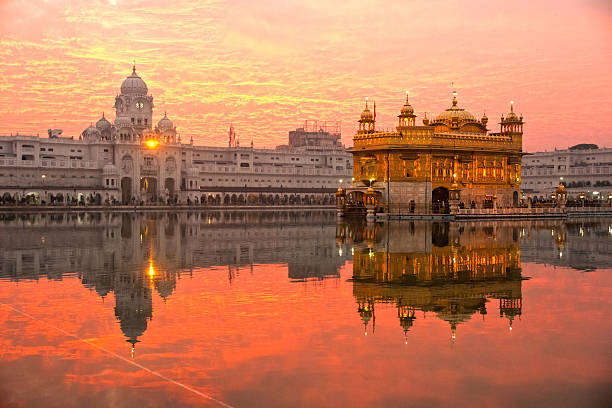
The Golden Temple (also known as the Harmandir Sahib, lit. 'abode of God', Punjabi pronunciation: [ɦəɾᵊmən̪d̪əɾᵊ saːɦ(ɪ)bᵊ], or the Darbār Sahib, 'exalted court', or Suvaran Mandir [d̪əɾᵊbaːɾᵊ saːɦ(ɪ)bᵊ]) is a gurdwara located in the city of Amritsar, Punjab, India. It is the preeminent spiritual site of Sikhism. The man-made pool on the site of the temple was completed by the fourth Sikh Guru, Guru Ram Das, in 1577. In 1604, Guru Arjan placed a copy of the Adi Granth in Harmandir Sahib. The Gurdwara was repeatedly rebuilt by the Sikhs after it became a target of persecution and was destroyed several times by the Mughal, political parties and invading Afghan armies. Maharaja Ranjit Singh, after founding the Sikh Empire, rebuilt it in marble and copper in 1809, and overlaid the sanctum with gold leaf in 1830. This has led to the name the Golden Temple.